
Dopamine helps wearable drug-delivery electrodes last longer
FAYETTEVILLE, GA, UNITED STATES, August 20, 2026 /EINPresswire.com/ -- Researchers have developed a dopamine-enhanced
Press Release Disclaimer: This is a press release distributed through the XPR Media network. It has not been independently verified by our newsroom.
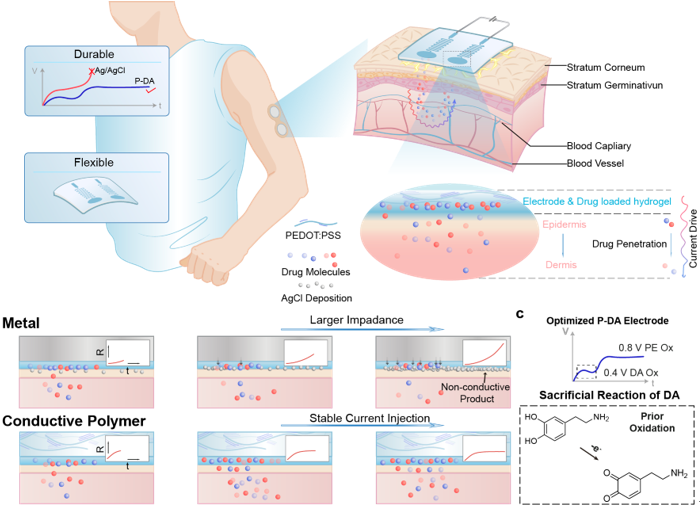

FAYETTEVILLE, GA, UNITED STATES, August 20, 2026 /EINPresswire.com/ — Researchers have developed a dopamine-enhanced soft electrode that helps wearable drug-delivery patches operate more reliably in wet conditions. The additive improves the electrode’s structure, protects it during electrical operation and strengthens its attachment to the device. In laboratory tests using pig skin, the electrode delivered model compounds more effectively and remained functional during repeated use, offering a potential route to longer-lasting iontophoresis patches.
A small amount of dopamine can help a soft electrode overcome three common causes of failure at the same time, researchers have found. The dopamine-enhanced electrode remained stable in wet conditions, operated for longer and supported more effective electrically assisted delivery through skin in laboratory tests.
Wearable drug-delivery patches can use a mild electric current, a technique known as iontophoresis, to help medicines move across the skin’s outer barrier. This could provide a needle-free way to deliver some treatments. However, the electrodes that drive the current can limit the performance of these devices. Conventional silver/silver chloride electrodes may develop a blocking layer during operation, while polymer electrodes can absorb water, swell and detach from their supporting surface.
To that end, researchers from The Chinese University of Hong Kong developed a new electrode by adding dopamine to PEDOT:PSS, a soft conductive polymer used in bioelectronic devices.
“Dopamine improves the electrode at several levels rather than only changing one property,” shares corresponding author Ni Zhao. “It helps organize the conductive polymer, protects it during electrical operation and strengthens the connection between the electrode and its supporting surface.”
The researchers found that dopamine helped the polymer form a denser and more orderly structure. “During operation, dopamine reacted before the main conductive polymer, acting as a sacrificial material that delayed degradation,” adds Zhao. “Its adhesive chemical groups also helped prevent water-related swelling and peeling.”
In durability tests, the dopamine-enhanced electrode operated for up to approximately 15 hours at a low current density. At higher current densities used for shorter delivery sessions, it continued operating for several hours. The researchers then tested the same electrode repeatedly on excised pig skin, replacing the skin sample every 30 minutes. “The electrode remained effective for up to 120 minutes,” says Zhao. “During the first use, its fluorescence signal was approximately twice that of unmodified PEDOT:PSS and four times that of a commercial silver/silver chloride electrode.”
“Additional diffusion-cell experiments detected the transport of both charged and neutral model compounds,” says first author Yixin Qi. “Cell tests showed no detectable cytotoxicity under the reported conditions, while a short forearm contact test showed no obvious visible irritation.”
Notably, the dopamine-enhanced electrode combines improved electrical stability, structural durability and wet-state adhesion in a simple polymer-based design, enabling more consistent transdermal delivery during repeated use.
“Going forward, the platform could be optimized for different drugs, current densities and personalized wearable delivery systems, as well as other skin-interfaced bioelectronic applications.,” adds Qi.
Nonetheless, the researchers noted that the current findings are mainly based on laboratory electrochemical tests and ex vivo porcine-skin experiments, while the human skin-contact assessment was preliminary and limited in duration. “Further studies should therefore evaluate long-term safety, drug-dose control and performance in diseased or damaged skin models, followed by well-designed clinical investigations,” says Zhao.
References
DOI
10.1016/j.wees.2026.03.004
Original Source URL
https://doi.org/10.1016/j.wees.2026.03.004
Funding Information
This work was supported by the Innovation and Technology Fund from the Innovation and Technology Commission of Hong Kong, reference No. ITS/218/22, and the RGC Senior Research Fellow Scheme, reference No. RFS2425-4S05. The funders played no role in study design, data collection, analysis and interpretation of data, or the writing of the manuscript.
Lucy Wang
BioDesign Research
email us here
Legal Disclaimer:
EIN Presswire provides this news content “as is” without warranty of any kind. We do not accept any responsibility or liability
for the accuracy, content, images, videos, licenses, completeness, legality, or reliability of the information contained in this
article. If you have any complaints or copyright issues related to this article, kindly contact the author above.

Media gallery


