Non woven Fabric Market to Reach USD 121.80 Billion by 2035 at 6.45% CAGR
The non-woven fabric market is growing, driven by rising healthcare needs, infrastructure use, automotive
Press Release Disclaimer: This is a press release distributed through the XPR Media network. It has not been independently verified by our newsroom.
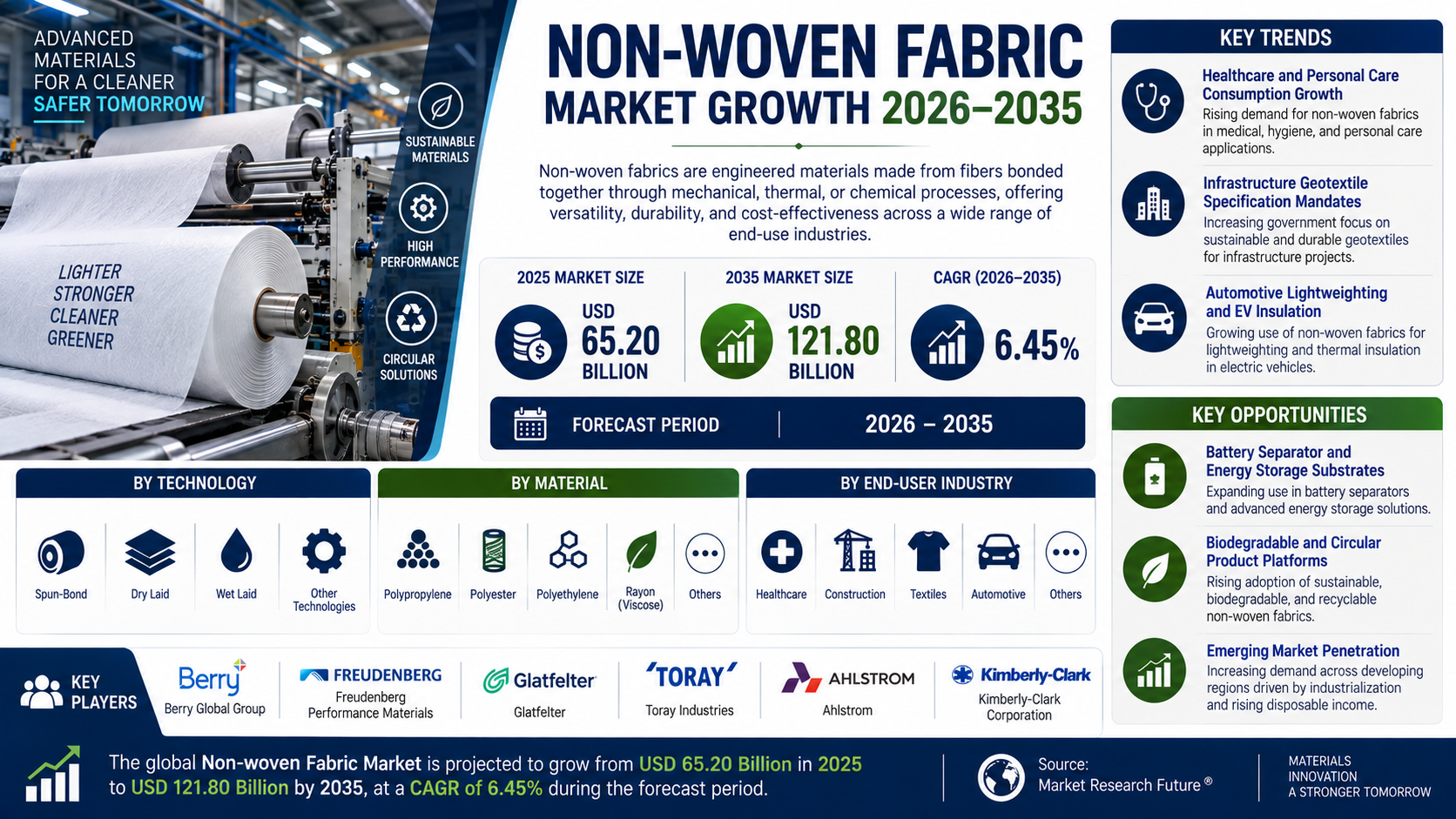

The non-woven fabric market is growing, driven by rising healthcare needs, infrastructure use, automotive lightweighting, and sustainable materials.
NY, UNITED STATES, September 17, 2026 /EINPresswire.com/ — The global non woven fabric market was valued at USD 65.20 Billion in 2025 and is projected to reach USD 121.80 Billion by 2035, registering a CAGR of 6.45% during the 2026–2035 forecast period, according to Market Research Future®. Demand is being supported by healthcare and personal care consumption, infrastructure development, automotive lightweighting, filtration applications and the expansion of advanced material technologies.
Non woven fabrics are engineered textile materials produced without conventional weaving or knitting. They are used across healthcare, construction, textiles, automotive, filtration, hygiene, packaging and other industrial applications. The market includes technologies such as spun-bond, dry laid, wet laid and other manufacturing processes, with polypropylene, polyester, polyethylene, rayon (viscose) and other materials serving different performance requirements.
Get Sample Report PDF| https://www.marketresearchfuture.com/sample_request/1762
Healthcare and Personal Care Remain Core Demand Drivers
Healthcare represents a major application area for non woven fabrics because of their use in surgical gowns, drapes, wound-care products, hygiene products and other single-use applications. The healthcare segment accounted for 45.8% of the market in 2025, making it the largest end-user segment.
Rising healthcare consumption and greater awareness of hygiene are supporting demand for disposable and absorbent materials. Growth in personal care consumption is also creating opportunities for manufacturers supplying substrates for wipes, hygiene products and related applications.
For producers, performance requirements such as softness, absorbency, filtration, strength and sterilization compatibility can influence material and technology selection.
Infrastructure Development Expands Geotextile Applications
Construction is another important growth area for non woven fabrics. Geotextiles can be used for separation, filtration, drainage and stabilization in infrastructure projects.
The construction end-use segment is expanding at a 6.1% CAGR as geotextile specifications become more established across infrastructure programs. This creates opportunities for non woven fabric manufacturers supplying materials for roads, drainage systems, building applications and other civil engineering projects.
Infrastructure investment can also support demand for technical textile solutions where durability, permeability and controlled material performance are required.
Automotive Lightweighting Supports Technical Fabric Demand
Automotive manufacturers are increasingly using engineered materials to reduce vehicle weight while meeting requirements for acoustic performance, thermal management and interior functionality.
Non woven fabrics are used in applications including headliners, wheel-arch liners, trunk trim, acoustic absorbers and battery-pack insulation. Automotive applications contributed USD 7.43 Billion in 2025, supported by cabin acoustic and battery insulation demand.
The transition toward electric vehicles creates additional opportunities. Battery systems require materials capable of supporting thermal management and insulation requirements, creating potential applications for specialized non woven substrates.
Spun-Bond Technology Maintains a Leading Position
By technology, the non woven fabric market is segmented into Spun-Bond, Dry Laid, Wet Laid and Other Technologies.
Spun-bond accounted for 49.2% of market share in 2025, reflecting its use in high-volume hygiene, healthcare and geotextile applications. Other technologies, including spun-lace and electrospun formats, are advancing at an 8.1% CAGR through 2035.
Dry laid technologies serve applications including automotive trim and wipes, while wet laid processes support specialty filtration and other paper-adjacent applications. Technology selection depends on product specifications, production economics and intended end use.
Polypropylene Remains a Major Material Choice
By material, the market includes Polypropylene, Polyester, Polyethylene, Rayon (Viscose) and Others.
Polypropylene represented 59.0% of the market in 2025, supported by its cost characteristics and suitability for high-volume applications. Polyester generated USD 12.06 Billion, while rayon (viscose) is expanding at a 6.9% CAGR as manufacturers explore cellulosic alternatives for applications such as wipes.
Material selection is increasingly influenced by performance requirements as well as sustainability considerations. Recycled and bio-based feedstocks are gaining attention as manufacturers and brand owners evaluate circularity targets and evolving regulatory requirements.
Sustainability Is Reshaping Product Development
Environmental considerations are becoming increasingly relevant to the non woven fabric industry. Manufacturers are developing biodegradable, recycled and bio-based material platforms that can address changing customer and regulatory requirements.
Circular product development can create opportunities for cellulosic fibers, recycled polyester and other alternative feedstocks. Product design is increasingly influenced by recyclability, material traceability and end-of-life considerations.
These developments are particularly relevant in European markets, where regulatory requirements are influencing substrate selection and product formulation.
Battery Applications Create an Emerging Opportunity
Battery separator and energy storage substrates represent an emerging opportunity for non woven fabric manufacturers.
Specialized non woven separator carriers can be combined with coatings or other treatments to address thermal management and safety requirements in energy storage systems. The growing battery manufacturing ecosystem is therefore creating opportunities beyond traditional healthcare, hygiene and industrial applications.
Qualification requirements can be demanding in battery applications, creating opportunities for suppliers that can deliver consistent pore structure, dimensional stability and controlled material characteristics.
Filtration and Advanced Medical Applications Add Growth Potential
Non woven fabrics are widely used in air and liquid filtration because manufacturers can engineer fiber structures for different filtration requirements.
Tighter air-quality standards and growing demand for high-performance filtration are creating opportunities for melt-blown, electrospun and other advanced material formats. Data centers, commercial buildings and industrial facilities can contribute to demand for specialized filtration media.
Advanced medical applications also provide opportunities for electrospun materials and nanofiber structures used in specialized wound-care products and other healthcare applications.
Emerging Markets Offer Expansion Opportunities
Emerging markets provide opportunities as healthcare access, hygiene consumption, infrastructure development and industrial manufacturing expand.
Asia-Pacific accounted for 44.7% of the non woven fabric market in 2025 and is expected to grow at a 7.0% CAGR through 2035. India is also expanding its manufacturing capacity through policy support for man-made fibers and engineered fabrics.
Local converting capacity and proximity to customers can become increasingly important because non woven fabric rolls are relatively bulky, making transportation economics an important consideration.
Regional Production and Demand Patterns Continue to Evolve
Asia-Pacific remains a major production and consumption center, supported by hygiene demand, industrial development and expanding manufacturing capacity.
North American demand is closely connected with healthcare, construction and geotextile applications, while Europe is increasingly influenced by circularity requirements, automotive applications and sustainable substrate development.
The regional market structure creates opportunities for manufacturers that can combine competitive production economics with specialized technical capabilities and sustainability documentation.
Competitive Landscape
The non woven fabric market includes global manufacturers and specialized technical-material suppliers competing across technologies, materials and end-use applications.
Key players include Berry Global Group, Freudenberg Performance Materials, Glatfelter, Toray Industries, Ahlstrom and Kimberly-Clark Corporation.
Competition is influenced by production scale, technology capabilities, application expertise, geographic proximity, material sourcing and sustainability performance. Manufacturers are also expanding capabilities in specialized areas such as filtration, healthcare, battery substrates and recycled materials.
Outlook Through 2035
The non woven fabric market is expected to continue expanding as healthcare and personal care consumption, infrastructure development, automotive applications and advanced material requirements support demand.
The shift toward electric vehicles can create additional opportunities for battery insulation and separator substrates, while infrastructure specifications can support geotextile consumption.
At the same time, biodegradable and circular product platforms are likely to become increasingly important as customers evaluate environmental performance, recycled content and end-of-life considerations.
The combination of established applications and emerging opportunities in energy storage, advanced filtration, medical materials and sustainable products will remain important to the market’s development through 2035.
Read the full Non woven Fabric Market Research Report:
https://www.marketresearchfuture.com/reports/non-woven-fabric-market-1762
Forecast Period: 2026–2035
2025 Market Size: USD 65.20 Billion
2035 Market Size: USD 121.80 Billion
CAGR: 6.45%
Related Insights
Soda Ash Market https://www.marketresearchfuture.com/reports/soda-ash-market-2339
India Adblue Market https://www.marketresearchfuture.com/reports/india-adblue-market-44226
India Epoxy Resins Market https://www.marketresearchfuture.com/reports/india-epoxy-resins-market-21396
Cold Storage Market https://www.marketresearchfuture.com/reports/cold-storage-market-9995
India Flat Steel Market https://www.marketresearchfuture.com/reports/india-flat-steel-market-47259
Market Research Future
+1 855-661-4441
email us here
Market Research Future
Legal Disclaimer:
EIN Presswire provides this news content “as is” without warranty of any kind. We do not accept any responsibility or liability
for the accuracy, content, images, videos, licenses, completeness, legality, or reliability of the information contained in this
article. If you have any complaints or copyright issues related to this article, kindly contact the author above.

Media gallery